The Inside Game is an independent publication for readers who want to look beyond the surface of a game. We follow design choices, play history, genre context, and the details that shape discovery-without pretending one verdict can fit every player.

Thoughtful routes through the games worth remembering

Clear context, considered interpretation.

Browse the archive

A shared way to look at games

The Inside Game publishes under one collective editorial identity. We bring documented game context together with clearly signposted interpretation, so readers can see where the record ends and our reading begins.

Editorial author portrait

Context first, interpretation in the open

Our scope spans reviews, discoveries, design analysis, play history, genre context, and reader questions. We explain the evidence and mechanics at hand, then make room for an independent response rather than presenting interpretation as an official statement.

About us

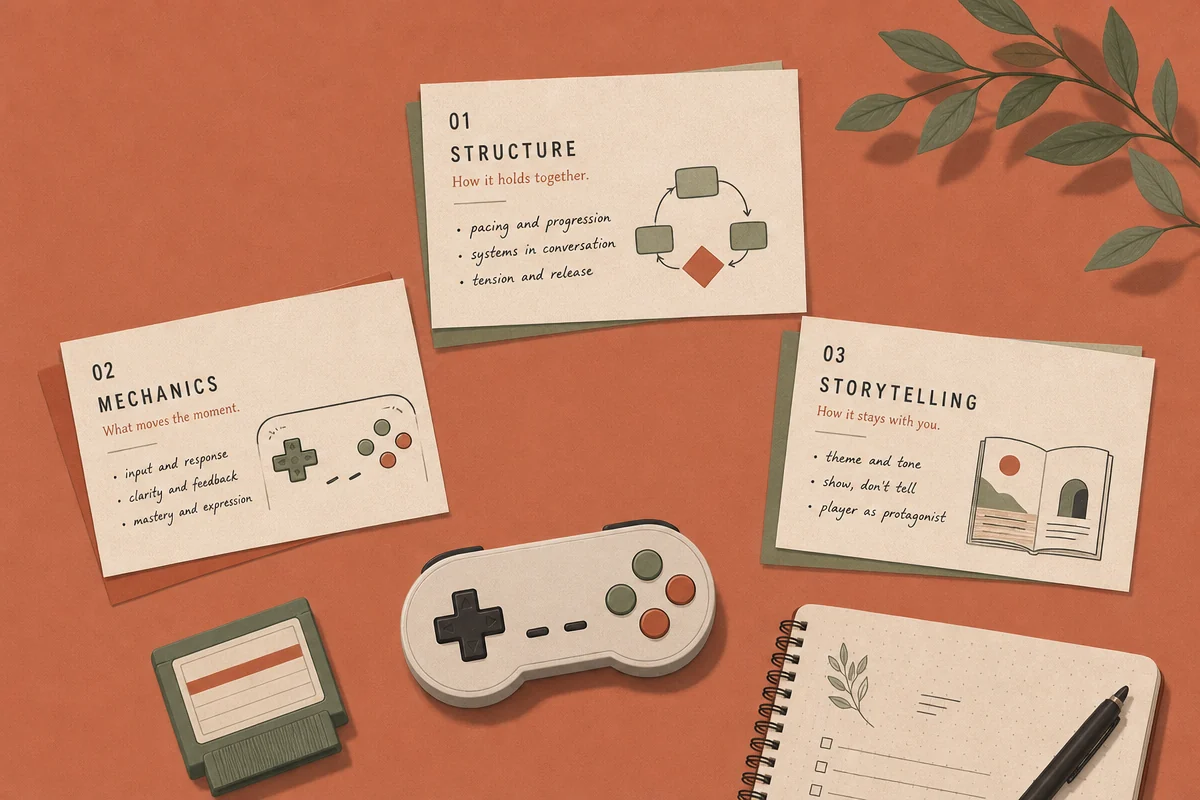
Three ways to look closer at a game

The archive gives you several ways in. Compare how games organise attention, decisions, and meaning, then follow the question that interests you into a focused feature.

Competitive readability

Street Fighter II: The World Warrior asks how distinct characters, readable spacing, round structure, and repeatable match decisions make competitive depth easier to read.

Dialogue-led storytelling

The Secret of Monkey Island brings dialogue, puzzle logic, and comic timing together, asking how interactive storytelling can feel conversational rather than simply delivered.

World structure and progression

The Legend of Zelda: A Link to the Past lets us examine how exploration, dungeon tools, and its Light World and Dark World structure make progression feel spatial rather than merely sequential.

Beyond genre labels: design detail

A genre label becomes more useful when it points to something you can observe. The Inside Game connects release context and platform conventions with the structures and mechanics that shape what a player notices, chooses, and understands.

Read the context, then follow the structure

Our genre deep-dives compare concrete mechanics and structures across selected games rather than relying on broad genre labels alone. Play-history features add the release-era and platform context needed to see how those conventions frame a game's design, while the wider editorial scope keeps the focus on accessible analysis, discovery, and player-facing detail.

Send a reader question

When context reshapes a format

Play history is most useful when it stays close to the design. Street Fighter II: The World Warrior places one-on-one matches, character-specific move sets, rounds, and six-button controls in the arcade setting of 1991. The Secret of Monkey Island takes a different route: its 1990 graphic-adventure structure brings point-and-click exploration, inventory-based puzzles, dialogue, and comic timing into focus.

Two eras, two ways of paying attention

One feature asks how an arcade fighting game makes spacing and repeatable match decisions readable through rounds and distinct move sets. The other looks at how a Lucasfilm Games adventure uses dialogue and puzzle logic to make interaction feel conversational. Together, they connect historical context with what each game asks the player to notice.

Compare the details

Three questions to take into the archive

The archive's three lead features are easier to choose when you start with a question. Follow a world that teaches through movement, a match that makes decisions visible, or a story that treats conversation as part of its puzzle structure.

If you notice routes first

Start with The Legend of Zelda: A Link to the Past and follow the connection between its overhead world, dungeon tools, and Light World and Dark World structure. The useful question is how progression changes when geography carries part of the explanation.

If you watch decisions unfold

Choose Street Fighter II: The World Warrior for a closer look at one-on-one matches, distinct characters, rounds, spacing, and six-button controls. The feature follows how repeatable match decisions become legible without reducing competitive depth to a single verdict.

If dialogue is part of the puzzle

Read The Secret of Monkey Island to examine point-and-click exploration, inventory-based puzzles, dialogue, and comic timing. Its route through interactive storytelling begins with the question of how conversation can guide action.

Stay in touch

Bring a question to the conversation

Have a question about a mechanic, a piece of play history, a genre connection, or a discovery? Send it to The Inside Game editorial team. A clear question gives the conversation a useful starting point.

Email

Share your question

[email protected]

Send a note about mechanics, play history, genre context or game discovery.

Phone

Have a conversation

+61 480 758 760

For a direct hello, give the editorial team a call.

Visit

Find us in Adelaide

313 Melbourne Street
North Adelaide, South Australia 5006

Our editorial home for curious conversations about play.

Start anywhere. A specific game, moment or idea is all you need to open the conversation.