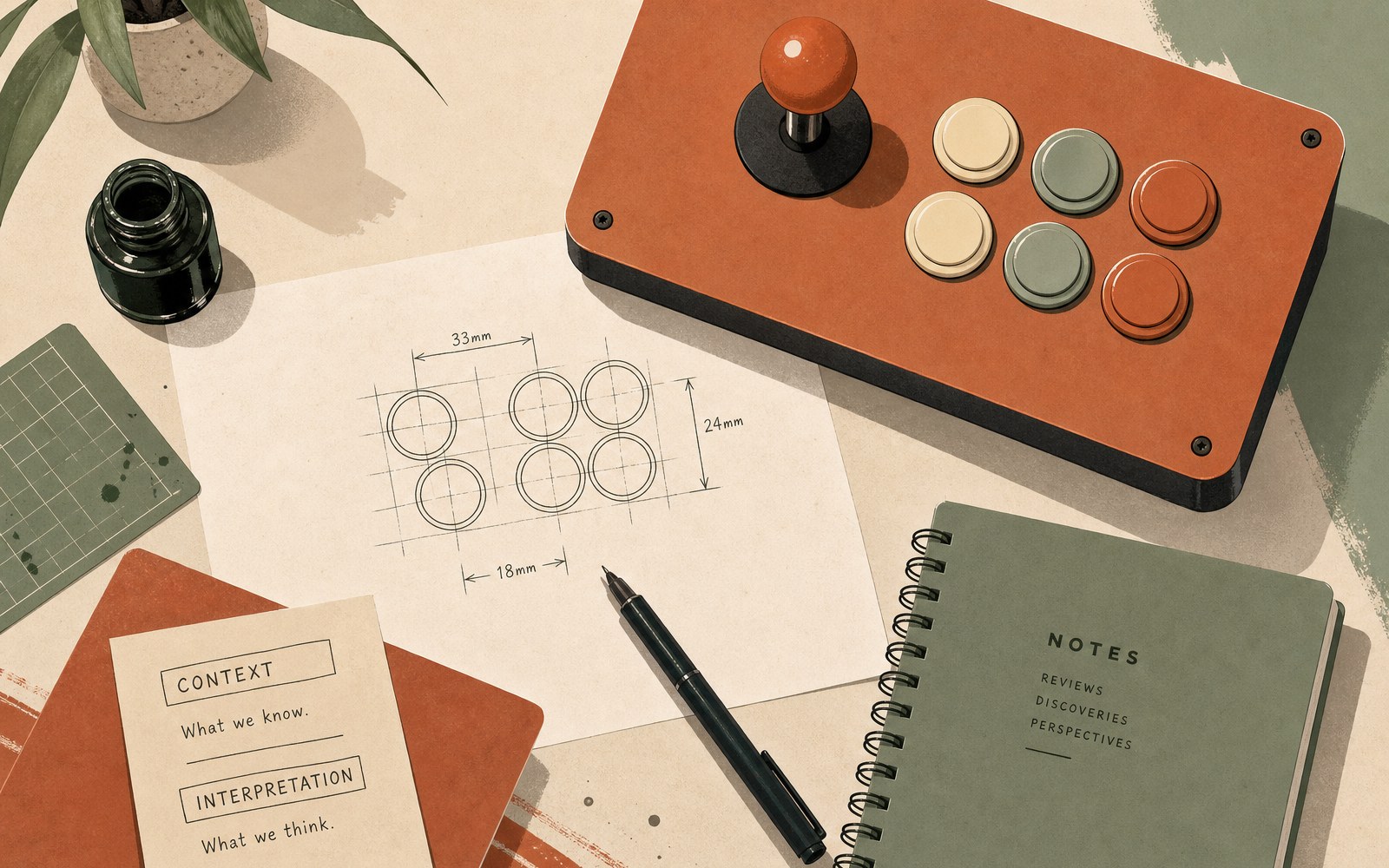
What makes a competitive game readable before it becomes deep? Street Fighter II: The World Warrior offers a useful answer. This fighting game, developed and published by Capcom for arcades, centres on one-on-one matches, character-specific move sets, rounds, and six-button controls. These features do more than organise competition. Together, they turn a match into a series of decisions that players can observe, remember, and interpret.
Distinct characters make choices easier to read
A character-specific move set gives each player a starting vocabulary. The characters are not just visual choices placed over the same ruleset; each one offers a different collection of options. Our reading is that this helps players connect an action with a possible intention. A movement, attack, or defensive response belongs to a chosen character, giving it a recognisable shape within the match.
This does not make the game simple; it makes the complexity easier to sort. Choosing different characters also means choosing different ways to approach the same one-on-one structure. That contrast gives players and spectators something concrete to compare: how a character occupies space, how its move set changes a decision, and how the other player responds.
Spacing turns the arena into a question
Spacing is the relationship between the two characters and the room between them. In Street Fighter II, that room is not empty background; it becomes a visible measure of risk and opportunity. A player can read whether a character is close enough to threaten, far enough away to reset the exchange, or positioned to invite a different response.
Spacing also helps the match make sense from outside the controls. Even without knowing every move, a viewer can see the players negotiate distance. One decision changes the available space; the next responds to it. The game communicates tension through position rather than explanation.
Our reading is not that every exchange has one correct interpretation. The value is in the repeatable question the arrangement creates: what can happen from here, and what will the other player attempt next? A clear question can support many answers without becoming obscure.
Rounds give decisions a clear shape
The round structure gives that conversation boundaries. A full match is not one uninterrupted stream of actions; it is divided into smaller contests, each with its own momentum and consequences. Players can recognise a pattern, adjust their approach, and return to the same problem from a changed position.
Rounds also make improvement easier to discuss. A player can look back at a particular exchange rather than trying to explain an entire session at once. The structure supports comparison: the same character, the same opponent, or the same spacing question can appear again, but with a different decision attached to it. In this way, the game creates a practical loop between observation and response.
Six buttons, one shared language
The six-button control scheme is another part of the game's readability. It gives the match a shared physical language, while character-specific move sets give that language different expressive possibilities. The layout is more than an input detail: it helps players connect a deliberate action with an on-screen result.
That connection matters because competitive depth depends on repeatability. A decision must be identifiable enough to attempt again, compare with another decision, and understand as part of a larger pattern. The combination of defined controls and distinct characters gives players a stable basis for that process, even as the match itself remains unpredictable.
Depth without a single verdict
Street Fighter II: The World Warrior does not make competition readable by removing uncertainty. It makes uncertainty manageable through a clear setting: two characters, a shared match structure, defined rounds, six-button controls, and space that can be watched as carefully as it is occupied.
That is why its design rewards closer attention. Competitive depth appears in the relationship between character options, distance, timing, and repeated decisions. Rather than treating a match as a test of hidden knowledge, the game gives players a structure in which knowledge can grow through comparison.